

Easily Explaining Bitcoin Core’s Memory Bug
I break down the Script Interpreter Remote Crash vulnerability (CVE-2024-52911) in simple terms and explain how it impacts the Bitcoin network. The CVE was publicly disclosed on May 5.


On May 5, more details were publicly disclosed about a high-severity vulnerability in Bitcoin Core code, the Script Interpreter Remote Crash (CVE-2024-52911).
The bug was discovered by Cory Fields (theuni on GitHub) in November 2024, and the fix was shipped in April 2025 with Bitcoin Core version 29.0.0.
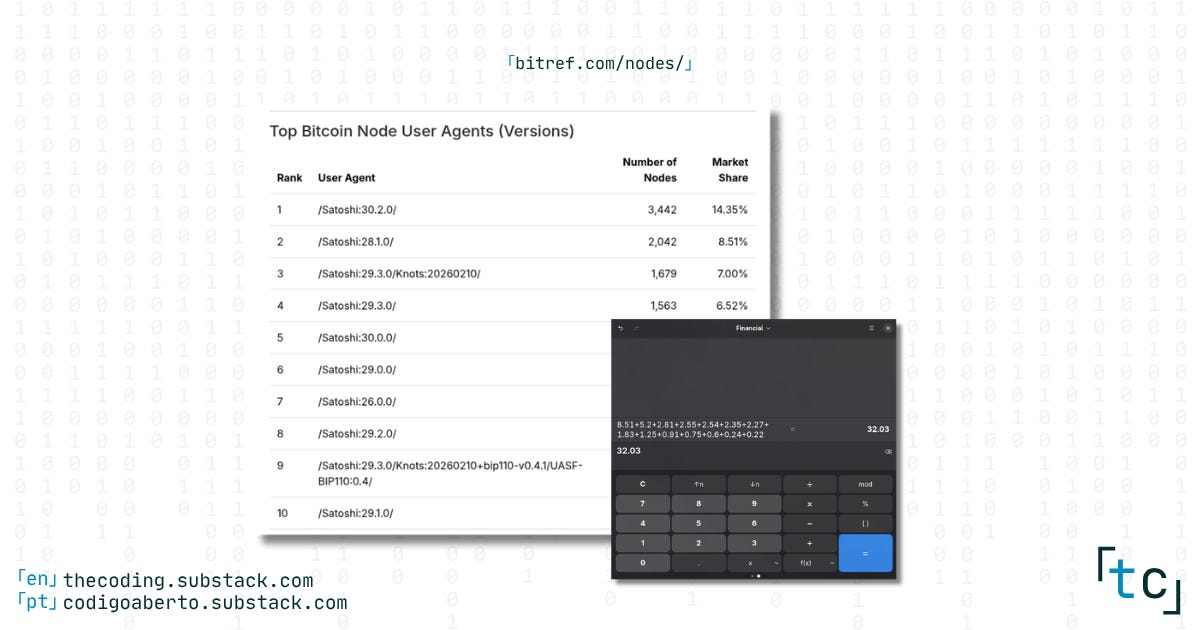
However, data from bitref.com shows that over 32% of Bitcoin nodes are still running unpatched versions older than v29 — meaning they’re still exposed to the bug.
According to Niklas Gögge, this was the first memory-safety bug in Bitcoin Core’s C++ codebase. The Rust community (a language that fixes many memory-safety issues) is already using the moment to push for porting Bitcoin to Rust.
But what exactly is this bug, how does it work, and what attack vectors does it open up for the Bitcoin network?
What Is the Script Interpreter Remote Crash (CVE-2024-52911)?
Bitcoin nodes are basically computers (or servers) running Bitcoin software (mostly Core or Knots) connected to each other. Together, they form the Bitcoin network.
These nodes validate blocks and transactions sent by miners to make sure they’re legit. Valid blocks get stored on disk and become the permanent transaction record for the whole network — basically the ledger that tracks every BTC balance in every wallet.
When a node receives a block, it has to check every transaction against the protocol rules. To make this efficient, the validation happens as a background thread through CScriptCheck.
Think of nodes like a logistics warehouse that receives trucks (blocks) packed with packages (transactions) that all need to be inspected and stored. The warehouse manager has other duties, so he hires a team of workers to handle the package checks in the meantime (the script check).
To know what to do, the manager gives the workers an instruction sheet. That sheet is the PrecomputedTransactionData function, which stores a bunch of pre-calculated data to speed up transaction validation. Every action the CScriptCheck workers take points back to more detailed info on that precomputed data “sheet.”
On top of that, the manager also hired a supervisor to oversee the whole operation. In code terms, that’s CCheckQueueControl.
The whole system runs smoothly as long as the node only receives valid blocks with valid transactions. The problem shows up when an invalid block arrives and needs to be thrown out.
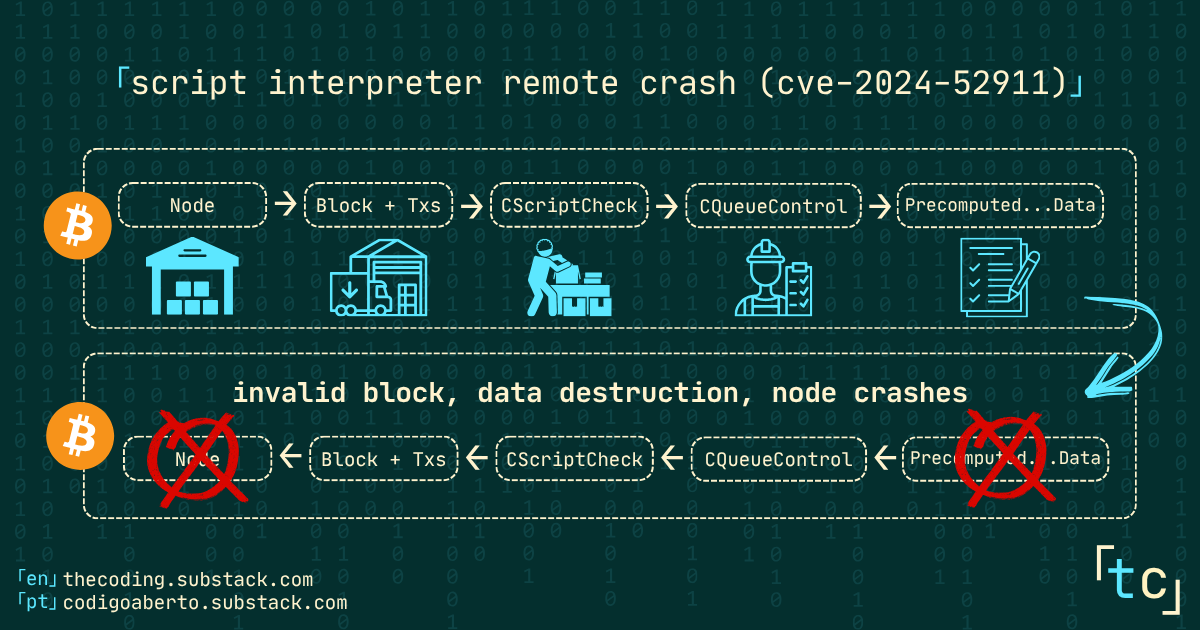
This stems from how C++ handles objects that need to be removed (destroyed) from memory. Destruction happens in the reverse order the objects were created.
In our analogy, the manager first hired the supervisor (CCheckQueueControl), then the workers (CScriptCheck), and finally handed out the precomputed data sheet (PrecomputedTransactionData).
When the invalid block has to be discarded, the manager throws away the data sheet first. Now both the workers and the supervisor are left pointing at instructions that no longer exist, creating total chaos.
At the code level, the script-check pointers now point to data that’s already gone, so the node crashes and restarts. If done on purpose, exploiting this vulnerability creates a denial-of-service attack.
Some theories also suggest a skilled attacker could achieve remote code execution (RCE) on the affected server — for example, installing malware or other exploits. In theory this is possible, but the Bitcoin protocol’s handling of arbitrary data makes it much harder in practice (that’s a topic for another post).
Any node running outdated software (pre-v29) is vulnerable. Updating to a patched version fixes the issue and stops the node from crashing.
Check out the video version of this article.
I hope this made the situation with Bitcoin crystal clear. If it helped, drop a like, leave a comment, and share it with your friends so more people understand the bug.
Thanks for reading 「 thecoding 」!
You can already use BTC and other cryptocurrencies to pay for AI!
NanoGPT is a pay-per-prompt AI aggregator with native crypto payments accepted and a privacy-friendly setup. You can make micro deposits to the app (even $1) and pick from dozens of models. I’ve been using it for years, since its alpha release.
Registering through my link below gives you lifetime 5% discount in all your queries. Try with small amounts first!