

Meet Ika: Multichain wallet in one Solana account
Let's dive in and understand IKA's solution and the 2PC-MPC protocol developed by dWallet Labs for native cross-chain operations on Solana and Sui, all protected by cutting-edge cryptography.

I have been wanting to write about Ika for a while now.
The opportunity finally came up now that the project is migrating from Sui to Solana and conversations about security in MPC (Multi-Party Computation) solutions have heated up following the exploit against THORChain's MPC.
So, let's break down what Ika is and why it matters right now. As always, I'll cover the technical side and explain how everything works in an easy way.
If you follow my content, you know I'm a big fan and active user of NEAR Intents and other cross-chain protocols (like THORChain and Maia Protocol), plus I'm a NEAR validator. None of that changes with this article, even though there's some obvious competition between these projects.
I don’t mind, really. IKA is a genuinely impressive project that deserves the highlight (just like NEAR).
As a user and researcher, I love the redundancy here. It's healthy to have strong projects competing to deliver the best solutions, each making different trade-offs — giving us the flexibility to use whichever one (or all of them) makes the most sense depending on each situation.
Enough with the intro, let's get into the IKA protocol!
This article is sponsored by dWallet Labs, the core developer behind the Ika protocol and Encrypt. Their support made it possible for me to spend the time researching, understanding, writing, and editing this piece. The content remains fully authentic and didn’t suffer any direct influence from the team, that respected the independent creation.
Check the carrd below to meet my services and how I work in sponsorships.
Meet IKA: Bridgeless Capital Markets
“Ika enables a bridge-less capital market,” is how the team positions the product that is now focused on Solana infrastructure, while promising to “move value between any blockchain without bridges, wrapping, or centralized custody. Powered by dWallets and 2PC-MPC cryptography.”
“Ika enables a bridge-less capital market”
I’ll explain.
The core idea here is to abstract away the fragmentation between different crypto networks. You get a single wallet (dWallet) running on one network (Ika), secured by strong cryptography, that can control native accounts across many other blockchains.
IKA is a decentralized network of MPC signers. It functions as a trustless cryptographic bridge between chains, but it’s not a bridge in the traditional sense we’re used to in crypto.
Think of it as a shared, programmable signature service running on its own chain (a fork of Sui).
The signers work like validators in a traditional blockchain. They stake a minimum amount of the token (40M IKA, currently) and get the right to sign transactions in the network’s behalf. We will expand on that soon.
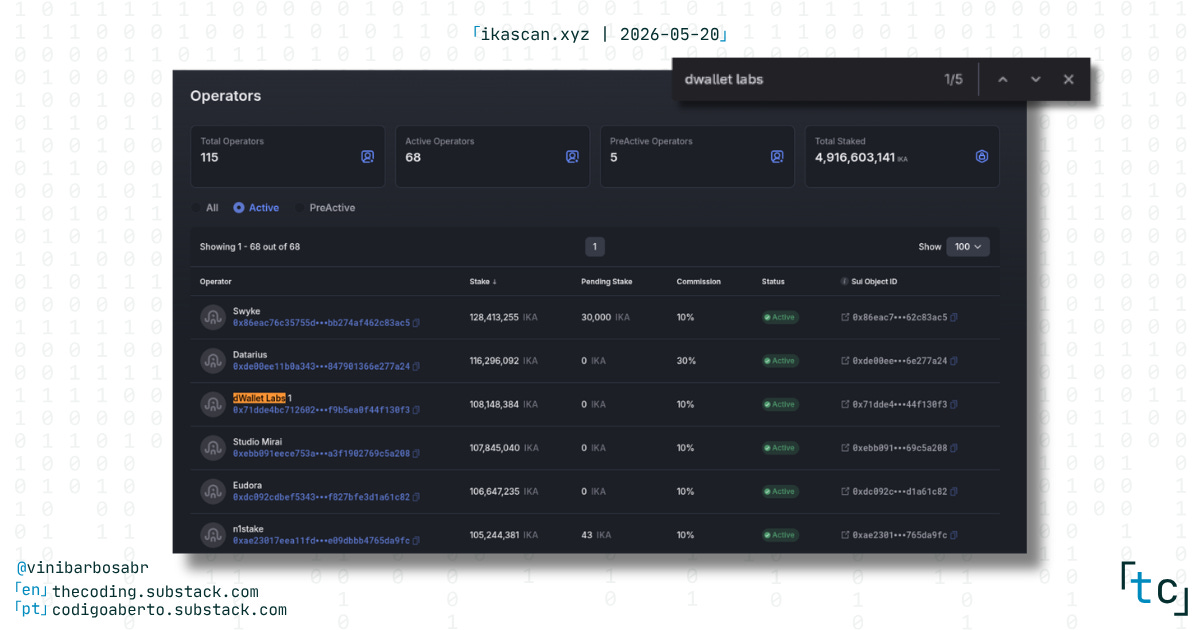
Right now the network has 68 active operators (producing signatures) out of 115 total operators. Anyone can spin up a node and join — it costs roughly $100–200/month in rented hardware, according to David Lachmish, CPO of dWallet Labs.
There’s already 4.91 billion IKA staked, and the top five operators control about 11.5% (~567 million). However, the signing capacity is not influenced by the staking amount. Worth noting: some of these operators are controlled by the same entities. For example, dWallet Labs runs five operators under the labels “dWallet Labs 1 through 5.”
Then, instead of relying on centralized custodians, traditional bridges, or small trusted committees, IKA lets smart contracts and users control native accounts on other networks (Bitcoin, Ethereum, Solana, Sui, etc.) through a decentralized network.
Even better: without ever exposing the full private key to any single party (it's not really a private key, we will get there).
This opens the door to advanced cross-chain operations while keeping solid security and decentralization standards. That’s especially relevant in a world where bridges have been responsible for the largest share of stolen funds from hacks and exploits. The “Bridgeless Capital Markets” north star makes a lot of sense and feels genuinely valuable, in my opinion.
The approach is similar to the MPC solution behind NEAR Intents and Chain Signatures (which I’ve written about before), but with some key differences, of course. The two biggest ones:
IKA is a permissionless network — anyone can participate by running a node and staking or receiving delegations.
It uses the 2PC-MPC Protocol (implemented by dWallet), which enables the Zero Trust setup where the user also holds private key shares in a 2-of-2 signing threshold. More on that below.
“Ika was built from first principles to be the definitive infrastructure for custody and interoperability. It’s the fastest, most scalable and most decentralized infrastructure existing today, but the biggest unlock is the zero-trust setup Ika uniquely enables. For crypto’s vision of self-sovereignty without trusted 3rd parties to materialize and gain mass adoption, the future of both custody and interoperability must be zero-trust, and Ika is the only infrastructure that can make that a reality.”
— David Lachmish, CPO of dWallet Labs
dWallet and the 2PC-MPC Protocol
Before we go further, it’s worth clarifying the solution is not built for casual retail users, but aimed at developers and advanced users who are fine with programming and the CLI (command line interface).
On that, there is no colorful, cute dWallet mobile app you can just download and tap around in your iPhone. Anyone can create and use a dWallet through the CLI (I did it myself while testing), but the target audience right now are developers building on Solana (and previously on Sui).
In practice it looks like this: a Solana dev integrates dWallet into their app’s backend → the end user interacts with it through that app running all the technology we are discussing here.
Nevertheless, it’s still useful to understand how the piece of software running inside your favorite wallet works, even if you’re not a developer.
How dWallet Works
dWallet is the main product built on top of Ika and is basically the interface that gives meaning to it. You (the user) can use this interface for three types of wallet that dWallet allows:
Imported Key: This mode happens when the user does not generate a new key by dWallet, but imports a seed or private key generated in other traditional crypto wallets. It’s useful mostly for self-custody applications.
Zero Trust Mode: This mode uses the 2PC-MPC protocol and generates two shares of the private key through a Distributed Key Generation (DKG) method. One for the user (you) and the other for the MPC network (Ika). No part can see the share of its counterpart and both are needed to sign valid transactions (2-of-2 threshold).
User’s Public Share: This one follows the same premise of the second, generating two shares of the private key. The difference is on how the user share is stored. Here, it is stored publicly in the blockchain (e.g., in a smart contract) and can be called by apps or other programs to sign transactions for the user, while Ika’s MPC continues guaranteeing its safety.
Our focus here will be to understand the Zero Trust mode because it is the project’s biggest competitive advantage and also helps to understand the third mode — which we can explore in a future article.
Ika’s Zero Trust Mode
I like to think of it as a safe vault that requires two combinations to open. One by the vault’s owner (you) and the other by a company specialized in vault security (Ika).
When the safe was first configured using a system developed by this company, you entered a dark room, alone, and generated your combination. The other share was generated the same way by an automated system in the company’s database and immediately encrypted before being stored.
Therefore, what the company stores is actually the encrypted version of their combination share and not the combination itself (in plain text). The signing happens using something called homomorphic encryption — performing signing operations on encrypted data without ever decrypting the company’s combination. The MPC network share never gets exposed.
To open the safe, you first need to insert you combination and call the company to do the same. After receiving your request, Ika will call a council made by its operators, where each one has the right to one vote. With two-thirds of the votes, the signing is done and the second combination is inserted, opening the safe.
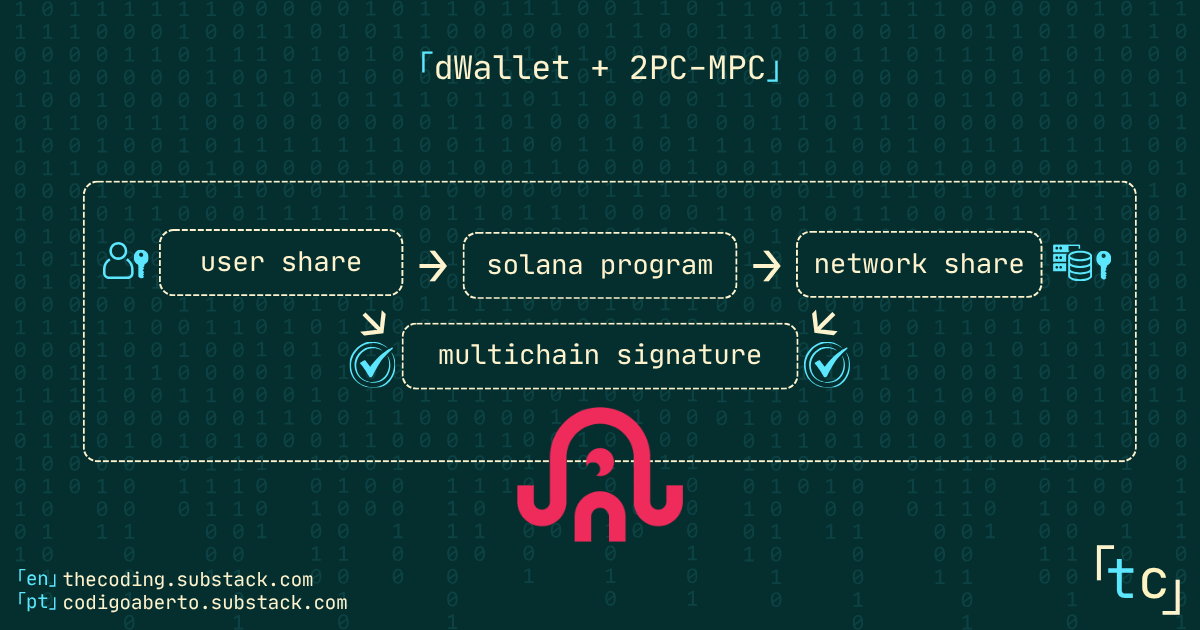
The full combination is never reconstructed in one place. Everything is encrypted with strong cryptography, and each part’s share is protected from the other part, creating mutual, zero-trust relationship. Beautiful!
Interestingly, you can also store the user share with redundancy in different places with more confidence, as a leak is not as harmful as it usually is in normal crypto wallets because the network share is still needed to move funds.
David recently explained that on X.

Likewise, dWallet allows the user to set custom policies for its use and interactions, all programatically. This policy may enable more complex operations (in DeFi, for example), more or less security according to the user's needs, and other interesting features.
There’s one important limitation that applies to pretty much every MPC solution:
The user will always need the second half of the key held by the Ika operators. That means we can’t just export a full private key and import it into a regular wallet the way we’re used to in crypto.
Unless when using the self-custody, imported key mode.
In short, dWallet controls addresses on other chains by generating valid signatures (ECDSA, EdDSA, Schnorr, etc.). DKG generates two shares (user and network) with secrecy. The wallet is also programmable and transferable — the user can transfer control to someone else with safety.
“the future of custody and interoperability needs to be zero-trust”
Also, the public key is derived as usual and looks exact the same as public addresses from the supported networks (Bitcoin, Ethereum, Solana, Sui, etc.). No over-complication for the user while managing crypto addresses and receiving payments.
There’s more interesting detail worth covering (pre-computed MPC signatures for improved performance, wallet transfers and other functionalities, for example), but this article is already getting long. I’ll save some of that for a follow-up if there’s interest. I would also like to write about the economics around IKA’s token.
Yet, I hope this one gave you a solid first look at the project and got you curious to dive deeper.
BUG BOUNTIES: dWallet Labs doesn’t have a bug bounty program live yet, but the team told me they’re planning to launch one soon. I’ll post about it on X or in Substack Notes the moment it drops — I’m planning to join the bug bounty hunt.
My Take on IKA
The project feels solid, technologically innovating, and genuinely promising. The team comes across as highly competent, with cybersecurity and engineering backgrounds, and they love to discuss and explain these and other things on X.
IKA is easily one of the few projects I have in my radar this cycle. I’ve been studying and discussing it for a while (especially with David), and the solution feels elegant on multiple levels.
Decentralization, permissionless network, cryptographic security, and open-source development (a lot of it in Rust, btw) are all things I value a lot.
The move to Solana makes complete sense (though I’d still love to see native dWallets on NEAR someday, lol). I’m confident we’ll be hearing a lot more about IKA in the months ahead.
Drop your thoughts or questions in the comments — I’ll answer everything I can, or point you to the right person if I don’t know the answer myself.
Thanks for reading 「thecoding」!
Follow me on X at vinibarbosabr and subscribe for free to [en] thecoding.substack.com or [pt-br] codigoaberto.substack.com for more pieces like this.