

[Opinion] Voting AGAINST HSP-007 on NEAR House of Stake
HSP-007 is live for voting on the NEAR governance platform House of Stake (HoS) and here is my reasoning for voting AGAINST it.

HSP-007 is live for voting on NEAR governance platform House of Stake (HoS).
The proposal is to “establish a sustainable MPC node infrastructure financing program” that is funded via ~10% of the treasury.near allocation (2.5%) from protocol emissions.
I’m leaning towards an AGAINST vote (253k veNEAR).
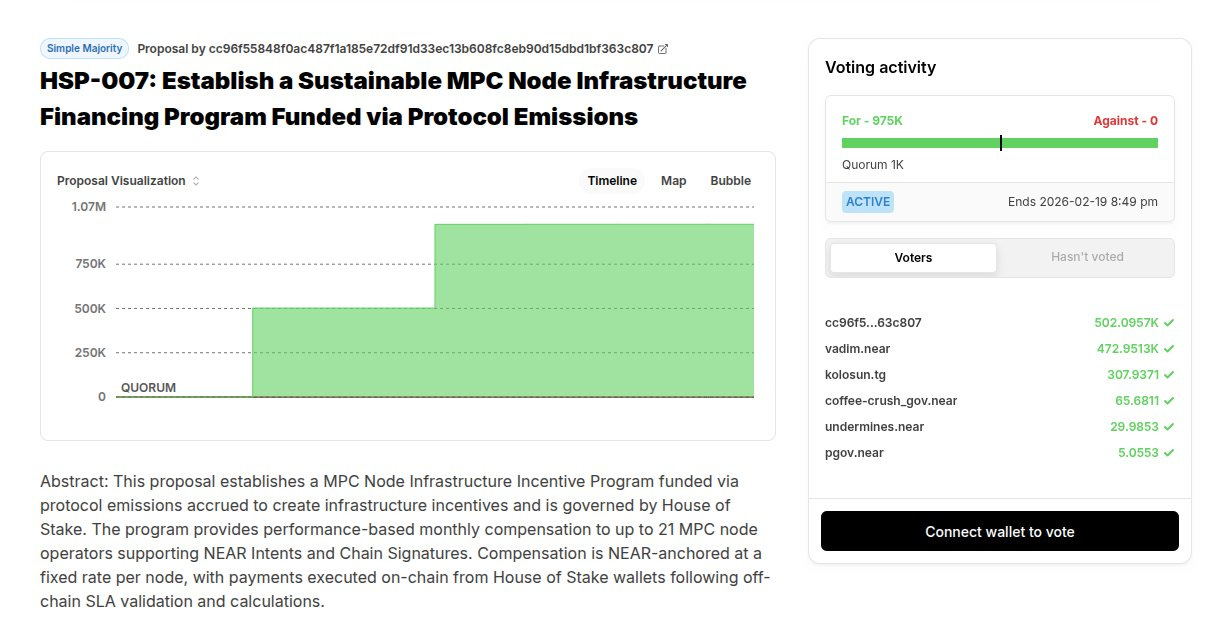
Despite leaning towards an AGAINST vote...
I do agree that a financing program is positive & needed and that the MPC node infrastructure is of extreme importance for the NEAR ecosystem, the NEAR 0.00%↑ token, and the vision.
I just don’t agree with the current state of the proposal.
It needs to be improved with more clarity, more discussions, and a better financing-calculation mechanism (or a more open and permissionless infrastructure, opening the program for a wider range of potential beneficiaries).
Lowering the payments, balancing the risks, or opening the network to more participants would reduce the weight of this proposal and facilitate a ‘FOR’ vote.
Let’s dive into my reasoning ↓
My main reasoning for an AGAINST vote is that:
A. "With great power comes great responsibility"
- Uncle Ben
(i). This is the first significant funding proposal on HoS, which carries massive weight as it sets precedent for future, similar proposals.
(ii). It's still not clear who the other 11 MPC node operators (beneficiaries of this proposal) will be or how they will be selected/gatekept.
(iii). The funding represents a significant part of treasury.near allocations.
(iv). As is, I see huge upside with low downside potential (long term) for the beneficiaries, with higher chances of treasury.near overspending.
All that requires better standards and greater scrutiny.
B. I don't think the program is clear enough in some important nuances -- for example what I mentioned in A(ii) or in its calculations.
Referent to the calculations (to illustrate it not being clear), Exhibit A's image shows a simulation that contradicts the proposal's text.

In this simulation (posted in the gov forum and also in the GitHub repo linked to the voting proposal), the "Ceiling Trigger" caused an increase in the "NEAR per Node Floor" (4,800Ⓝ)
→ causing an overspending of $14,400 vs. the $5,700 estimated costs.
However, the ceiling cap should exist to prevent overspending, as mentioned in the quote below, not the opposite of it:
"Cap on Program Incentives: Similarly, thisproposal provides a structure which caps the USD equivalent upside at $3 as NEAR prices rise materially to protect the protocol from overpaying for MPC nodes."
This looks like an honest mistake while designing the simulation (swapping floor logic for ceiling logic), but it highlights the lack of clarity in these mechanics and what stakeholders are actually voting into (we have some early FOR voters that either ignored this mistake, or believed the simulation reflects the desired outcome).
If it's not a mistake, then I misunderstood the cap logic and the proposal is even worse than I thought, as MPC node operators would be receiving more NEAR at higher NEARUSD rates, increasing even more their USD-nominal payments.
C. I and others have made counterproposals to improve the calculations, which were acknowledged and appreciated by Sal Ternullo, but not implemented (which is fair and I highly appreciate the work Sal and the SVRN team have put into making this proposal).
You can read a dedicated post I made about that below ↓
![[Report] SVRN Proposes Financing Structure for NEAR MPC Node](https://substackcdn.com/image/fetch/$s_!KQvD!,w_140,h_140,c_fill,f_webp,q_auto:good,fl_progressive:steep,g_auto/https%3A%2F%2Fsubstack-post-media.s3.amazonaws.com%2Fpublic%2Fimages%2F8b9e1c84-2875-4140-b33b-054a531de555_1232x886.png)
I believe these counterproposals would help address some of my concerns by:
(i). Better balancing the risk distribution between the beneficiaries and HoS's treasury.near (currently weighted towards HoS that is taking bigger risks)
(ii). Reducing the impact of NEARUSD price volatility in the program
(iii). Having an easier-to-understand mechanism
→ improving both the voting, execution, and monitoring
I will not send my vote yet, as I will remain open to 'FOR' arguments or corrections in case I misunderstood something.
This is a very important proposal that affects:
1. NEAR token
2. NEAR ecosystem and network
3. NEAR Intents and Chain Signatures
4. NEAR HoS Governance
Another thing that I would like to point out here as a strong reason to vote AGAINST this proposal in its current form (so we can improve it) is that the 21 handpicked MPC node operators would be receiving higher NEAR-based monthly rewards than what the top 5 NEAR validators get from a 5% pool fee.
For the calculation:#5 bitwise_1.poolv1.near | Ⓝ20M delegated | 5% fee | 4.90% APY (per near-staking)
→ Ⓝ20,000,000 x 0.049 = Ⓝ980,000 (near-staking estimated APY)
→ Ⓝ980,000 x 0.05 = Ⓝ49,000/year (validator’s fee)
→ Ⓝ49,000 / 12 = Ⓝ4,083
While beneficiaries of this proposal would receive Ⓝ4,600
So, I do agree that the Chain Signatures and NEAR Intents infrastructure is important to NEAR but I don’t see how it could be more important than the NEAR infrastructure itself.
Paying more protocol-based rewards to the former creates weird incentives and dynamics, imo. I really don’t think I can agree with that, having NEAR and HoS best interests in mind, sorry.