

Quai Network: Entropy, Energy Cash, and Scalability
A technical look at Quai Network’s Proof-of-Entropy-Minima consensus, hierarchical sharding, SOAP merged-mining, and the dual-token design of QUAI + energy-pegged QI with its cash-like privacy model.

My technical curiosity on Quai has been sitting in the back of my head for a while. Every time Matt or Alan appeared on X posts & spaces the itch came back, but something else always took priority. I finally decided to stop putting it aside.
Quai Network seems to me as one of the more ambitious attempts to keep Proof-of-Work relevant at scale. For all these months of delaying this research, one thing I’ve always been sure: the tech stack is super intriguing and it’s definitely an interesting project worth studying.
In this piece we will look carefully at the architecture, the consensus innovations, the two-token system (QUAI + QI), the privacy proposal of QI, and a brief look at the tokenomics — it may deserve its own economic-focused article later, though.
Introduction
Quai is a hierarchical, sharded Proof-of-Work network backed by a dual-token system. Its consensus is called Proof-of-Entropy-Minima (PoEM).
Instead of simply racing for the highest difficulty block, miners compete on the total entropy removed from the system.
It’s a pretty smart design, if you ask me. This gives continuous, measurable finality rather than the binary “longest chain” design of classic Nakamoto consensus — thinking about Bitcoin and similar, here.
The execution layer is sharded. If you follow me long enough, you know I’m a huge enthusiast of sharding, having written and contributed to NEAR, MultiversX, and Radix, for example.
Quai uses a Prime → Region → Zone hierarchy. In theory, documentation claims this structure can scale to 50,000+ TPS once enough zones are active. This is purely theoretical, though, and I’m highly skeptical of purely theoretical claims. I would need to see some real tests backing these numbers before I could endorse them.
Public tests before mainnet reached roughly 4,700–7,000 TPS in a nine-shard topology, which is already impressive for a PoW chain. These are the numbers I’m looking to and am also excited about.
As of August 2026 only the Cyprus-1 zone is live on mainnet; additional shards are expected to activate automatically according to demand, when block gas usage and uncle rates cross certain thresholds.
Transactions are cheap and confirmation is fast because of short block times and the entropy-based ordering. The network also supports multi-algorithm mining (KawPoW, SHA-256, Scrypt) through a mechanism called workshares and a protocol-level subsidy system named SOAP (Subsidized Open-market Acquisition Protocol).
On top of this infrastructure sits a deliberate dual-token design:
QUAI — account-based, EVM-compatible, intended as a programmable store of value.
QI — UTXO-based, fixed-denomination, energy-linked medium of exchange with cash-like privacy features.
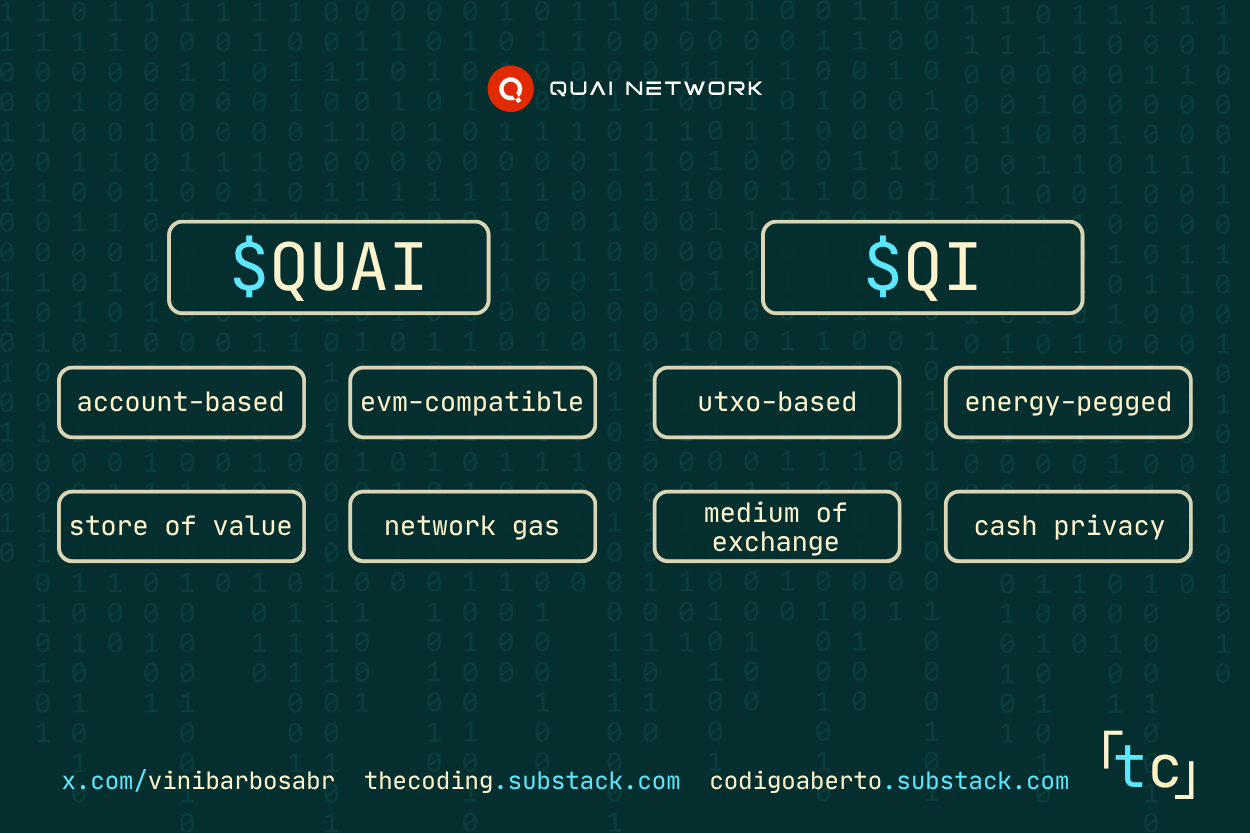
Miners choose which token they want as reward on a per-block basis. This is the foundation of Quai’s monetary experiment, which I also find interesting while holding some reservations about.
We will dive into all that now!
This article is sponsored by Dominant Strategies (Quai core team). Their support made it possible for me to spend the time researching, understanding, writing, and editing this piece. The content remains fully authentic and didn’t suffer any direct influence from the team, who respected its independent creation.
Quai and QI Easily Explained
Easily put, QUAI is positioned as the “digital gold + smart-contract fuel.” It lives on an account model like Ethereum, on top of the Quai Network. You can write contracts, deploy DeFi, and it aims to become a scarce asset as issuance slows down backed by strong maths.
QI is closer to digital cash. It lives on a UTXO ledger (like Bitcoin) but with strict rules that enforce more privacy and more fungibility by default (more than BTC, at least).
Its value is designed to track the real energy cost of producing it. There is no pre-mine and no fiat collateral (like dollar-pegged stablecoins). Every new QI enters circulation only through mining or conversion from QUAI.
Because the two tokens serve different roles, miners and users can express different preferences. Someone who wants programmable money and long-term scarcity can hold QUAI. Someone who wants everyday payments with better privacy can prefer QI. This is the design.
Conversions between the two exist on-chain (with a current two-week lock) so the system can rebalance.
On the tech side, the infrastructure operates similar to Bitcoin. Miners point their computers to the network and generate proof of computational work (hashrate).
However, instead of basing its consensus on a minimum difficulty threshold alone (as Bitcoin does), it requires precise entropy scores. The official documentation example is perfect to easily understand this difference:
Traditional Proof-of-Work asks a simple question: “Does this block meet the minimum difficulty requirement?” If yes, the block is considered valid. If no, it’s rejected.The Issue: This ignores the actual work done. Imagine two students taking a test:
Student A scores 85%
Student B scores 95%
Both pass the 80% requirement, but Student B clearly did more work
Traditional PoW treats both blocks as “equally valid” once they pass the threshold. PoEM recognizes that one block always represents more work than another.
Intrinsic block weight is like a “work certificate” - it measures exactly how much computational work went into creating a specific block.Think of it as the difference between:
Pass/Fail grading (traditional PoW): “Did you meet the minimum?”
Precise scoring (PoEM): “Exactly how well did you do?”
This precision allows PoEM to make instant, objective decisions about which block represents the most work and should be accepted by the network.
PoEM, SOAP, Merged-Mining and Related Mechanisms
Proof-of-Entropy-Minima
Classic Proof-of-Work orders competing chains by the highest cumulative difficulty (the “heaviest chain”). Every block that meets the difficulty target is treated as equal. PoEM changes that.
Instead of adding difficulty thresholds, PoEM measures the intrinsic entropy removed by each block — how much randomness the hash actually eliminated from the genesis state. The more leading zeros (or more precisely, the higher the intrinsic block weight), the more entropy was removed.
Single-block entropy ≈ 1 / 2^leading_zeros

Example:
• 16 leading zeros → removes 1 in 65,536 possible states
• 17 leading zeros → removes 1 in 131,072 possible states
Total chain entropy is the product of every block’s entropy (stored in practice as the sum of bits for efficiency). Because multiplication is strictly ordered, two honest nodes that see the same set of blocks will always pick the exact same tip. There is no temporary split that later needs resolution.
This produces two concrete advantages:
Statistical finality arrives faster: a short sequence of high-entropy blocks quickly becomes astronomically expensive to rewrite, meaning more resistance against forks.
All valid work contributes. There is no “orphan tax” on near-misses the way classic PoW has. Miners are always contributing and being rewarded according to their workshares.
Workshares and Proportional Reward Splitting (PRS)
Workshares are lower-difficulty proofs of work. They do not create a full Quai block, but they still remove entropy and get included in the next valid block.
The protocol runs a soft economic target of 8 workshares per block (params.ExpectedWorksharesPerBlock = 8). This value sets both the share difficulty and the denominator used for proportional payout. There is also a hard protocol-enforced cap of 32 workshares that can be included in any single block (raised from 16 at the Singularity fork).
Because workshares are generated far more frequently than full blocks, they give the protocol a much more accurate real-time sample of who is actually contributing work. Quai uses this sample for Proportional Reward Splitting: the block reward at each height is divided among the block producer and every included workshare, proportional to the work each one proved.
Solo miners therefore receive direct payouts for their shares without needing a centralized pool — something most PoW ecosystems have failed to achieve in a decentralized way. At the same time, research on PRS shows that the threshold for profitable selfish mining rises (an attacker needs >38 % hashrate under realistic parameters before the strategy becomes rational).
In short: workshares turn near-misses into paid, entropy-contributing objects and make reward distribution fairer than any traditional pool approximation.
SOAP and Multi-Algorithm Merged Mining
SOAP (Subsidized Open-market Acquisition Protocol) inverts the economics of other merge-mining systems we are used to in crypto.
Miners can point existing SHA-256 (BCH) or Scrypt (LTC/DOGE) hardware at Quai if they want -- and only if the mining pool they are using supports this feature.
When a parent-chain block is found, 100% of its coinbase is forced to a protocol-controlled address (QADDR). That address sells the parent coins (BCH, LTC, DOGE) on the open market, buys QUAI, and burns every token purchased. The miner is compensated in QUAI through the workshares that were included in the KawPoW block.
The best part: miners have full autonomy into deciding and adjusting their workshare pointed to each algorithm (and chain). The market sets the pace and drives the incentives.
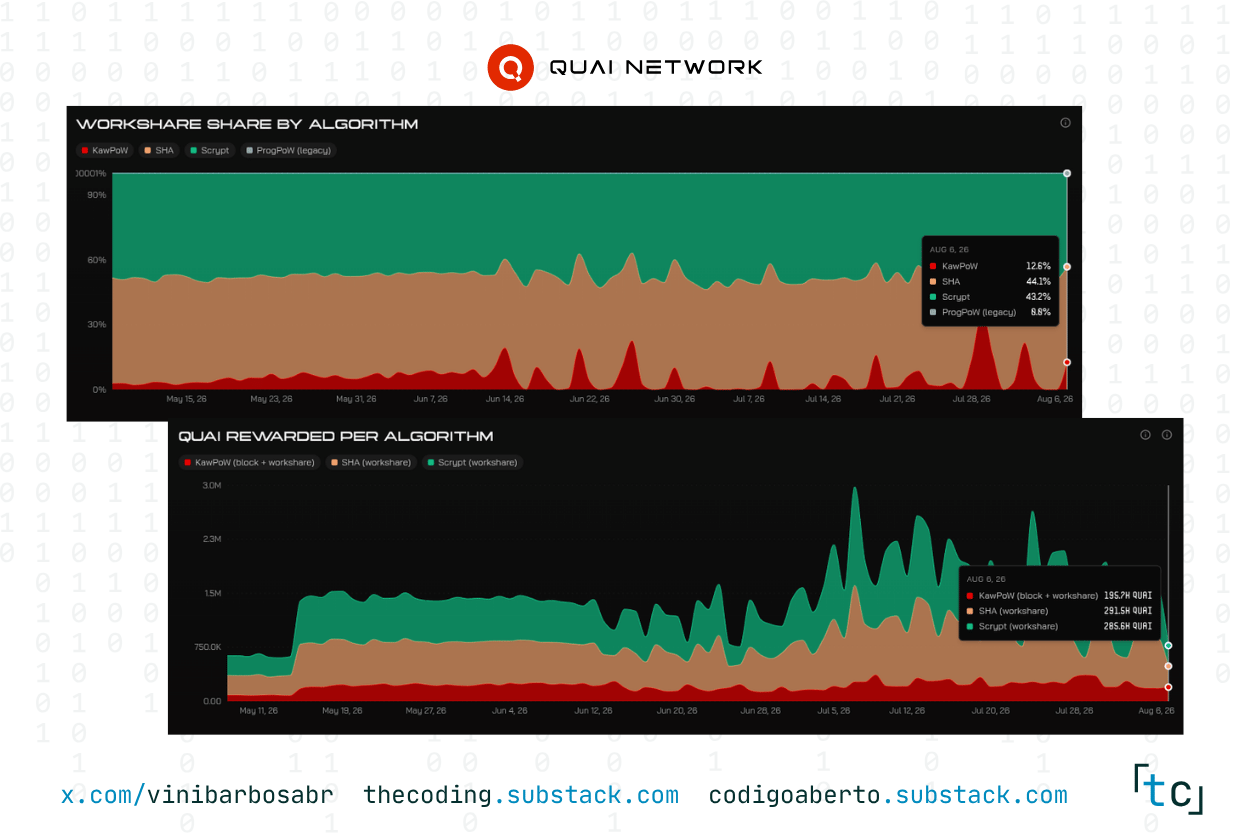
Nevertheless, only KawPoW miners produce Quai blocks.
The other algorithms contribute pure external hashrate and continuous buy-and-burn pressure on QUAI. The net effect is external security budget that might even contribute to the deflationary elements of the token.
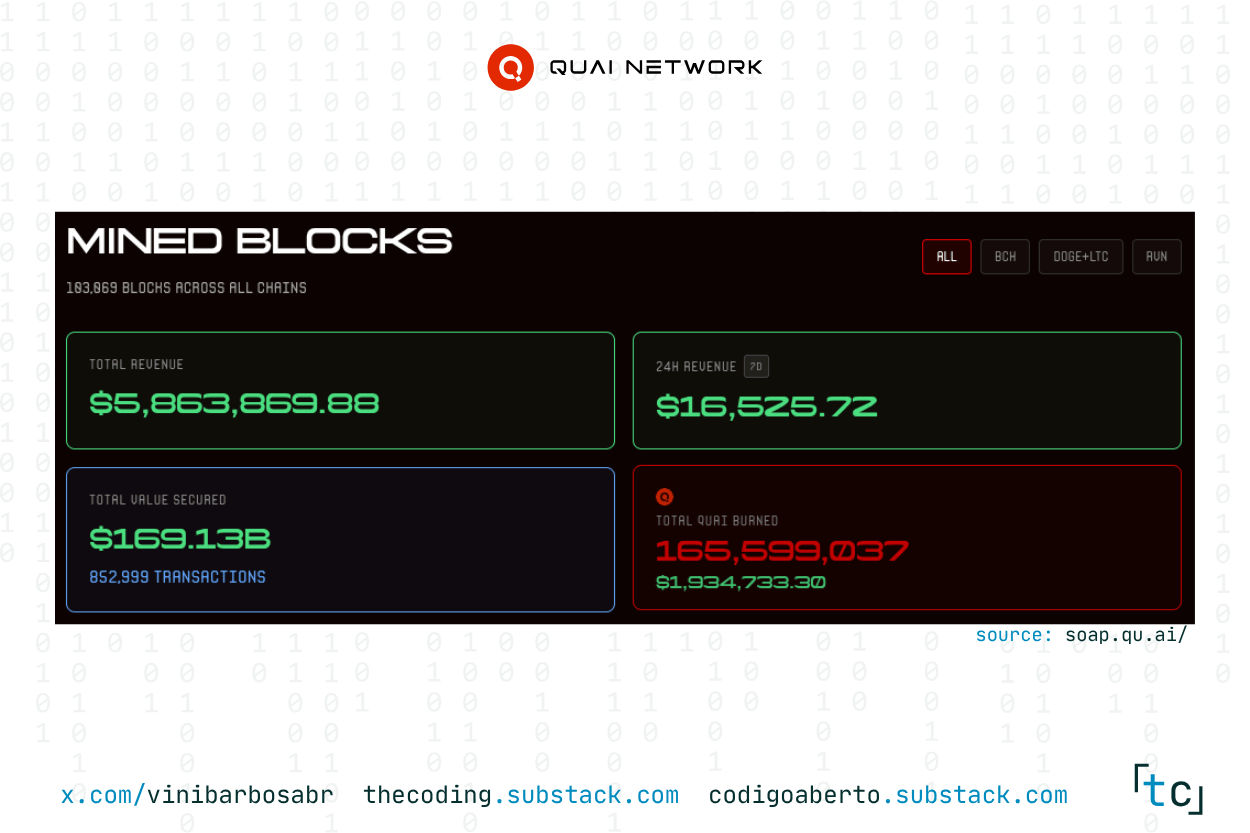
As of early August 2026 the mechanism is live and the cumulative parent-chain revenue routed through SOAP already sits in the millions of dollars, with more than 165 million QUAI permanently burned.
QI: The Cypherpunk Energy Cash
QI’s value proposition is straightforward: it is money whose issuance is tied to real energy expenditure and whose privacy model tries to recreate the properties of physical cash.
Cypherpunk enough? I think so.
Let’s see what privacy properties it has.
QI uses four structural rules that aim for privacy, rather than zero-knowledge proofs (Zcash) or FMCP++ (Monero):
Enforced non-address reuse — every output address in a transaction must be unique.
Payment codes (BIP-47 style) — a reusable identifier that lets the sender derive a unique one-time address via Diffie-Hellman. The payment code itself never appears on-chain (I’ve tested it!).
Fixed denominations — only 16 rounded allowed values (0.001 QI up to 1,000,000 QI). Arbitrary amounts are impossible; every payment looks like a collection of standard “bills.”
Incentivized cooperative reaggregation — consolidating many small UTXOs into larger ones requires interaction with other users and is restricted, increasing mixing.
// TxOut defines a Qi transaction output.
type TxOut struct {
    Denomination uint8     // Fixed denomination index (0–16)
    Address      []byte
    Lock         *big.Int  // Block height the entry unlocks. 0 or nil = unlocked
}
The result is described by the team as “transparent but untraceable.” In a private chat, this design decision was described to me as a focus on “scalable privacy”.
Full nodes see the complete UTXO set, but linking payments to a long-term identity becomes very expensive, especially at scale.
There are currently no plans to add native shielded or zero-knowledge features to the QI ledger or to the base protocol, primarily because of the latency and state-storage costs that would come with them on a high-throughput sharded PoW chain.
That said, the EVM-compatible QUAI side can already host existing privacy applications (Railgun-style, TornadoCash-style, or any other ZK circuit deployed as a smart contract). Native QI privacy remains structural by design.
Privacy comparison (tech wise)
Stronger than plain Bitcoin UTXOs.
Slightly weaker to Zcash Orchard/Ironwood (Halo 2 proofs) and Monero (FCMP++)
Intentionally chosen for scalability over absolute cryptographic privacy, but good enough for most use cases.
Focused on increasing its anonymity set through scale (having more users using the privacy feature, which strengthens the overall privacy experience for everyone)
My concerns on the two-token design
Separating the three classic properties of money (medium of exchange, unit of account, store of value) creates real economic challenges.
First, because liquidity is already hard enough to bootstrap and maintain for single-token systems. This challenge is already seen in many other crypto projects with good tech but low adoption and liquidity. Splitting the design risks splitting liquidity as well, which could slow down adoption.
Constant mining sell pressure on QUAI, the current two-week lock on conversions, and the need to grow two separate markets all increase the coordination problem. SOAP and the Singularity burn help offset some of the sell pressure, but the dual-token experiment is still young and liquidity remains thin.
Second, because all three properties are desirable for a monetary system that people can really use at scale and trust, in my opinion. Remove one pillar and the system weakens significantly.
Matthew Poletiek (@mattman), disagree with my second take, offering a clear counter-view in private conversation:
“Most people with a fundamental understanding of economics wouldn’t consider the USD a store of value. TradFi has gold and mutual funds for this very reason. So if we agree USD isn’t a store of value we can understand why it might not be a good idea to force 1 token to be both a store of value, medium of exchange, and unit of account.”
Alan (@0xalank) made a related point: crypto has never actually produced a true network-native unit of account — only hypothecated ones.
Both observations are fair.
Whether Quai’s deliberate separation of roles will prove more robust than forcing a single token to do everything remains an open empirical question. The experiment is worth running, as long as all participants are aware of its experimentation nature and stay clear-eyed about liquidity and coordination risks involved.
Closing Thoughts
I believe Quai is one of the most technically ambitious PoW projects of the current cycle, with a super interesting tech stack.
PoEM, workshares, hierarchical sharding, and SOAP form a coherent attempt to keep energy-based security competitive at high throughput, scale, and performance.
QI’s cash-like privacy model is a thoughtful, scalable alternative to heavy zero-knowledge or ring signature systems and provides a very satisfactory level of privacy and confidentiality to its users. It’s a true cypherpunk project in my opinion.
The open questions are mostly theoretical, economic and operational:
can the dual-token system maintain balanced liquidity, foment adoption, and generate demand?
how far the sharding architecture can lead the chain to meet real demand?
will the structural privacy of QI prove itself in adversarial environments?
I will be watching closely from now on, while trying to have these questions answered.
Drop your thoughts or questions in the comments — I’ll answer everything I can, or point you to the right person if I don’t know the answer myself.
Thanks for reading 「thecoding」!
Follow me on X at vinibarbosabr and subscribe for free to [en] thecoding.substack.com or [pt-br] codigoaberto.substack.com for more pieces like this.